Witchcraft supplies & wicca supplies online from one of the USA's BEST pagan Witchcraft Store Online!! RATED in the top 10 Witchcraft Stores online for our exclusive Witchcraft Supplies
A Practical Samhain Practice - A Witchcraft BLOG
A Practical Samhain Practice: Household Devotion, Boundaries, and Tending the Dead Without Making Autumn a Performance BLOG
A witchcraft blog on our witchcraft supplies store online By Tirza Cook
Our witchcraft supplies store is blessed with a talented group of witches who help us write and perform pagan rituals for the devotion of gods and goddesses, or to mark the witchcraft seasons of the year, the so called “wheel of the year” and of course intentional wicca and witchcraft rituals to heal or bless or protect..
Tirza is one such super talented young witch and blesses us with her witchcraft blogs for our witchcraft supplies online store! A good witchcraft supplies store like ours is so much more than just a wicca store... We are a community center and center of pagan worship, spellcasting and rituals...

October can make even a steady spiritual practice feel like a test.
The pressure is everywhere: elaborate ancestor altars, immaculate photographs of seasonal rituals, lists of things you're supposed to do before Samhain, and the unspoken suggestion that autumn has only been properly observed if it transforms you. For some people, that's energizing. For others, it's exhausting. I'm one...my birthday falls on Halloween and my October is always jam packed.
A good seasonal practice shouldn't make you feel behind. It should help you notice where you are, what needs care, and what you're ready to release. It should give you a way to relate to the dead, to change, and to your own limits without demanding spectacle.
Samhain has roots in Gaelic seasonal tradition and is widely understood as a threshold between harvest and winter. Contemporary pagan practice varies enormously. Most of us aren't recreating an ancient rite exactly. We're building honest practices from surviving history, community custom, personal devotion, and the real conditions of our lives. That gives us permission to stop performing an imagined past and practice with integrity now.
This October, I invite you to approach Samhain through three ordinary but substantial practices: tending your household, remembering the dead with discernment, and strengthening the boundaries that make meaningful connection possible.
Start With the Life You Actually Have
Before you set up a special altar, look at the space you inhabit every day. Not the version of your home you wish you had, and not the photo-ready corner you could create if you bought enough objects. The real place: the kitchen counter with mail on it, the laundry chair, the car that needs clearing out, the bedroom where you keep falling asleep with your phone in hand.
Household devotion begins there.
Care work is invisible until it isn't done. Floors get dirty, food runs out, lightbulbs burn out, and clutter collects in the same places. None of this is glamorous, but these recurring tasks are where we meet time most directly. They show us what a body needs to live and what a household needs to function. They remind us that spiritual life isn't separate from maintenance.
You don't have to cleanse every room, purge every possession, or build a ritual around every chore. Choose one place that has started making your life harder than it needs to be, and tend it deliberately.
Place Practical action Devotional focus:
Entryway: Sweep, clear shoes and bags, wipe the door or threshold How you enter and leave your own life
Kitchen: Clear one counter, wash a neglected dish, restock a basic food Nourishment and resourcefulness
Bedroom :Change bedding, clear the bedside, air out the room Rest and the right to be off-duty
Bathroom: Clean the mirror or sink, discard empty containers Care for the body without criticism
Altar or shrine: Dust, replace stale water, remove objects you no longer use Attention rather than accumulation
Bag, car, or workspace: Empty old papers and receipts; name one unfinished task
Keep your language simple while you work, and speak only if speaking helps you focus. You might say:
"I am making this space easier to live in."
Or:
"I am caring for the life I have, not punishing myself for the life I have not built."
That second line matters in a season when reflection slides easily into self-judgment. Household devotion isn't an aesthetic. It's a relationship with the conditions that support your life.

Seasonal Practice vs. Seasonal Performance
There's nothing wrong with enjoying candles, pumpkins, dark florals, old photographs, incense, or a beautiful ritual setup. I'm guilty, I love beauty too. A thing of beauty is a joy forever, afterall. Beauty helps us pay attention and can make a practice feel set apart from ordinary time. But decoration doesn't automatically become devotion.
A ritual becomes meaningful through the relationship you build with it: repetition, intention, and follow-through. One good candle used each week may serve you better than a table of objects you feel guilty for not using. One honest offering can be worth more than an elaborate display made from obligation.
Before adding something to your practice, ask:
Will I use this more than once?
Does it support a relationship I'm already tending?
Do I have a place to keep it after October?
Would a simpler version serve me just as well?
There's no shame in wanting a beautiful object. Ritual tools can carry memory, pleasure, and significance. The question is whether the object becomes part of your practice or becomes proof that you have one. If you're gathering supplies, bring a short list and choose things you can imagine using in November, January, and March, not just during the most photographable weeks of the year. A candle holder, journal, divination deck, offering dish, incense you genuinely enjoy, or a small piece of devotional art can become a long-term companion.
Buy for continuity.
Tending the Dead With Honesty
Samhain is often associated with ancestors and the dead. This can be a rich practice, but it deserves more care than the cheerful phrase "honor your ancestors" sometimes allows.

Not everyone's family history is safe or uncomplicated. Some of us are estranged from relatives. Some have inherited patterns of violence, addiction, racism, religious harm, abuse, silence, or neglect. Some don't know their biological families, or are adopted, displaced, or cut off from a culture of origin. Some are grieving a death recent enough that an ancestor altar feels unbearable. Some have loved dead who weren't related by blood but shaped their lives more deeply than family did.
You don't need to turn pain into a spiritual lesson. You don't owe an offering to someone who harmed you. You don't have to create closeness where there was none, and you don't have to forgive in order to observe the season.
You're allowed to be specific. Instead of calling only on "the ancestors," name the people, communities, and values you can approach with genuine respect. You might honor:
A beloved grandparent or elder
A friend, teacher, partner, or mentor who has died
Artists, activists, healers, or writers whose work gave you language for your life (think of pop-culture prayer candles)
Queer, trans, disabled, immigrant, or working-class forebears whose survival widened the world
Ancestors of place: the people, human and more-than-human, whose lives shaped the land where you live
The unknown dead whose sacrifices you benefit from, while acknowledging that history is rarely simple
This isn't an excuse to flatten history into comfort. It's an invitation to make your practice truthful.
A Small Practice of Remembrance
Set out a glass or bowl of clean water. Add one item to focus your attention: a photograph, a handwritten name, a stone, a flower, a piece of jewelry, a recipe card. If you don't have an item, you don't need one.
Sit down and take a few steady breaths. Then say:
"I remember those whose lives made room for mine. I welcome only those who come in goodwill."
You can name specific people, share a memory aloud, or tell them what has changed since they died. You can also say nothing and sit quietly.
Don't force an experience. You may feel warmth, grief, anger, nothing at all, or several things at once. None of these proves or disproves the worth of your practice. Grief isn't a performance metric, and neither is spiritual contact.
When you're ready, thank those you chose to remember. Pour the water outside, at the base of a tree, or down the sink. Wash the bowl and return to your day.
The closing matters. It helps your nervous system understand the practice has ended, and it reinforces that remembrance is something you choose and tend, not something that must spill into every part of your life.
Hospitality Requires Boundaries
This season is often described as a time when the dead or spirits are nearer. Traditions and individuals understand that differently: literally, metaphorically, devotionally, or as a useful image for a season shaped by memory and death. Whatever your theology, boundaries matter.
An open door is not the same as having no door.
If you work with spirits, ancestors, divination, dreams, or deity, take a few minutes this October to review your agreements. Are you clear about when you're available for spiritual work? Do you have a way of beginning and ending? Do you know how to say no? Do you leave room for mundane explanations when you're tired, stressed, grieving, or overwhelmed?
Good spiritual hygiene isn't paranoia. It's discernment. Your body deserves rest, your home deserves to feel safe, and your time deserves protection. Not every strong feeling is a message, and not every coincidence requires interpretation.
A Home Boundary Practice
You'll need a few minutes and one physical action to mark the end: closing a door, drawing a curtain, washing your hands, turning off a candle, or stepping outside.
Stand at your front door, your altar, or the center of your home.
Put both feet on the ground and notice the support beneath you.
Name what you welcome: rest, honesty, beneficial connection, clear communication, protection, good counsel.
Name what isn't welcome: manipulation, fear, intrusion, unwanted contact, confusion that weakens you, anything that disrupts your well-being.
Say, in your own words: "Only what supports my well-being may enter this space. Everything else must remain outside."
Complete your closing action.
Do one ordinary thing right away: drink water, eat something, take a shower, text a friend, or return to a household task.
That last step isn't an afterthought. Grounding is part of the ritual. It tells your body you've returned to ordinary time.
Build an Altar You Can Actually Tend
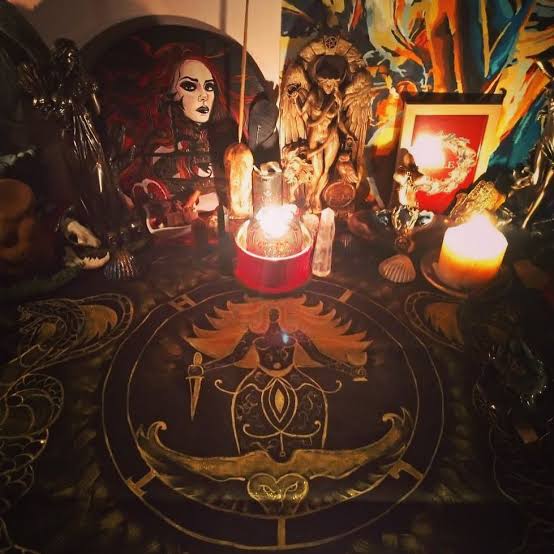
A Samhain altar can be as small as a windowsill, shelf, tray, or corner of a kitchen counter. It doesn't need to be permanent or contain every symbol of the season. It needs to be workable.
Candle or electric light: Light at the start of practice; turn off when done, creates a clear container without elaborate ritual
Glass or bowl of water, refresh regularly; offer in remembrance, supports a simple, repeatable ancestor practice
Small plate or bowl: Holds bread, fruit, sweets, herbs, or a written offering, gives offerings a defined place
Photograph, name, or meaningful object--focus on one person or relationship at a time. Keeps remembrance from becoming abstract or overwhelming
Journal and pen: Record dreams, memories, questions, and boundaries, builds continuity across the month
Stone, leaf, or seasonal object: Mark the passage of the season, keeps practice rooted in the tangible world
Cloth or tray: defines the edges of the space, makes setup and cleanup easier
A functional altar can change with you. If an object begins to feel heavy, remove it. If you can't manage a daily ritual, refresh the water weekly. If grief becomes too intense, put the altar away and return to something simpler: a candle, a walk, a meal with someone living.
Your altar works for you. You do not work for your altar.
A Week-by-Week Practice for October
If you want more structure, treat the month as gradual preparation rather than trying to do everything at once.
Week Focus Practice Reflection
Household care Tend one neglected area of your home. What becomes easier when this space is cared for?
Remembrance Set out water and name someone you remember with goodwill. What do I want to carry forward from this relationship?
Boundaries Complete the home boundary practice. What needs a clearer yes or no in my life?
Release and preparation: Clear your altar, refresh supplies, plan realistically for Samhain What can rest without being fixed tonight?
Samhain Observance: Share a meal, make an offering, journal, attend ritual, or rest. What did I learn by paying attention?
Use the plan as a guide, not an assignment. Missing a week doesn't invalidate the month. Start again where you are.
Questions Worth Sitting With
October reflection doesn't need to become an audit of your life. Choose one or two questions and return to them more than once.
What has supported me this year, in concrete terms?
What am I maintaining out of habit rather than choice?
What grief needs room, without being rushed toward resolution?
Whose memory do I want to hold with care?
Which inherited patterns do I want to stop repeating?
What kind of home am I making for myself and the people I love?
Where do I need a boundary before winter?
What can be allowed to rest?
What am I ready to tend patiently instead of urgently?
What would make the next season more livable?
Write plainly. You're not composing a beautiful spiritual statement. You're keeping company with your own life.
Gathering in Community: Rite of the Dark Goddess
Private practice matters, and so does community.
On Saturday, November 7, 2026, at 6:30 p.m., Artes & Craft will hold a Rite of the Dark Goddess, a Wiccan ritual created for our community. It isn't presented as a historical reconstruction.
"Dark Goddess" isn't one deity, one mythology, or one universal experience. For some practitioners, the phrase opens a relationship with a particular deity. For others, it names work with grief, endings, shadow, descent, anger, protection, mortality, or transformation. It can offer a way into difficult material that polite culture often asks us to bypass.

But difficult doesn't mean dangerous, and ritual doesn't require us to abandon good sense. A responsible community ritual offers choice. People can participate at the level that feels right to them. It doesn't demand disclosure, promise instant healing, or treat intensity as proof of depth. The purpose isn't to make darkness beautiful or easy. It's to meet what is present with honesty, boundaries, and care.
If you're preparing, stop by Artes & Craft, the Midwest's most specialized witchcraft supplies store, during October for a candle, journal, offering dish, grounding stone, or incense and herbs you already know you like. More importantly, come talk with us. Ask a question and tell us what you're working on. A local witchcraft supplies shop, at its best, doesn't sell you an identity. It supports real practice and a real community.
Samhain doesn't require a perfect altar, a dramatic revelation, or an answer to every question. It asks for attention: to the home you keep, the dead you choose to remember, the boundaries that preserve your energy, and the relationships you want to carry into winter.
That is enough. More than enough, really.
Sources and Further Reading
National Museum of Ireland, "Samhain"
Encyclopaedia Britannica, "Samhain"
University College Dublin, National Folklore Collection
The Irish Pagan School, "Samhain: History, Customs and Modern Practice"
Join us for the Rite of the Dark Goddess on Saturday, November 7, 2026, at 6:30 p.m. at Artes & Craft Pagan ritual supplies store.
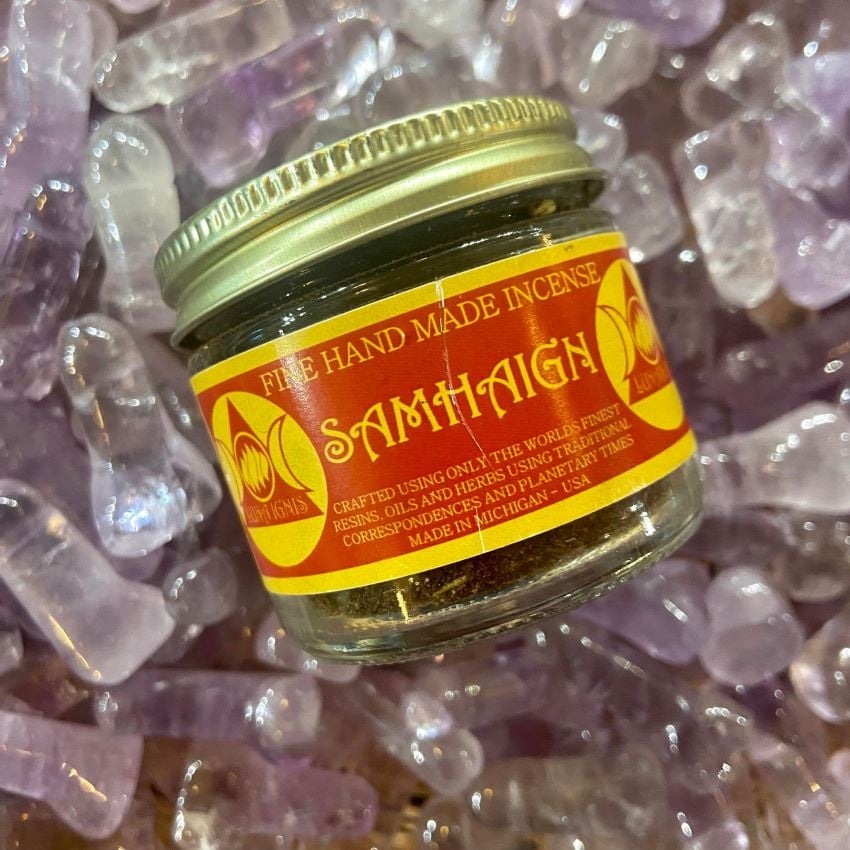
Here are some Samhain and Dark Goddess themed pagan ritual items on our witchcraft store online!!...
Our award wining witchcraft ritual spellcasting incense
SAMHAIN: Rituals, Recipes & Lore For Halloween (Llewellyn's Sabbat Essentials #6)
Lilith pagan witchcraft altar statue
Powered by Lightspeed
Display prices in:USD
